GROUP Dialogue with Obreau
Exploration for Understanding, then Action
Overview
Dialogue with OBREAU refers to two structured, facilitated processes for a group – large or small – to gain a deeper understanding of a complex, contested or uncomfortable issue. The first process, Intentional Observation Dialogue, is a complete, standalone method for helping the group clarify and examine what is real with the challenge now and what is more interpretation. This is useful when the group needs to establish more clarity and alignment of thinking before proceeding to further inquiry and/or action. (Full) Dialogue with OBREAU incorporates Intentional Observation Dialogue as the first of three movements of inquiry, the others being to shift perspectives to imagine specific stakeholder realities, and open space for personal sharing of what might otherwise be difficult to say. Both processes can be freely used under Creative Commons Noncommercial licensing. (A dedicated Intentional Observation Dialogue page will be available on this site shortly. The current version of this page focuses on full Dialogue with OBREAU.)
A process available for anyone, anywhere in the world, to use subject to the provisions of Creative Commons Licensing: CC BY-NC
Dialogue with OBREAU: Exploration and Understanding, then Action
Dialogue: A form of conversation oriented towards learning and understanding, rather than persuasion or decision-making. A dialogue can involve a group – large or small – or even just two people.
OBREAU: A conversation model based on three practices – Working from Observation, Attributing Reasonableness, and Speaking with Authenticity
Exploration: Emphasis on joint inquiry, learning more about an issue/challenge, especially through working from observable data and contemplating different perspectives
Understanding: An aim of a Dialogue with OBREAU is for all involved to gain a richer, fuller appreciation of the topic, and as far as possible, to build common understandings, while recognising that differences will likely remain.
then Action: One output of a Dialogue with OBREAU is ordinarily the identification of three focus areas for further work, or at least additional consideration.

Don Dunoon’s Introduction to Dialogue with OBREAU
“As a graduate student in Organisational Behaviour in the early 1990s, I became fascinated with dialogue through reading works of David Bohm and F. David Peat, and Peter Senge especially… Now, I want to make the Dialogue with OBREAU approach broadly available for anyone, anywhere in the world, to use under Creative Commons licensing: CC BY-NC.
“As the 1990s progressed, and following my graduate studies, I had the opportunity to experiment with dialogue in extended leadership programs I was conducting, as well as in my consulting practice. My interest was particularly in helping groups better make sense of strategic and other issues they faced. This was, admittedly, a more focused approach than that proposed by Bohm and Peat. Their emphasis was on dialogue as an open exploration between participants without a particular topic as the focal point of attention – ‘a free flow of meaning between people in communication, in the sense of a stream that flows between banks’[1].
“In my consulting work, though, I heard repeatedly of significant questions that executive groups and teams seemed either unwilling or unable to engage with. Examples included: ‘We say we value innovation in this organisation but little of it seems to be happening. How can we understand this?’ and ‘Our largest client seems to be slowly pulling away from us without making this explicit. What is going on in our relationship, and what might we do about it?’
“Over the years I have found it helpful to have an overarching question to help shape the dialogue, while recognising that the process of exploration in dialogue may lead the group to see the original question in a larger context and in a different manner than anyone in the group anticipated. For instance, the ‘lack of innovation’ question broadened into the group contemplating why it was that several of their stated values, such as respect and trust, were often not observed in practice.
“In the early years, one thing that struck me in dialogues I facilitated was that while many appreciated the power of dialogue in helping open-up different angles for thinking about thorny issues, some found the experience frustrating and difficult. They often struggled with holding their own opinions lightly, found the lack of structure disconcerting, and wanted to go directly to solving problems and proposing solutions.
“Skipping ahead a decade or so, and while writing my book, In the Leadership Mode, I framed ‘Three guidelines for safer intervention: Work from observation, Attribute reasonableness, and Seek to act authentically’ (p. 101). Later still, these became known as OBREAU – for observation, reasonableness and authenticity. While the OBREAU elements were initially framed as a structure for aiding leadership action by individuals, it progressively became clear to me that OBREAU was a powerful construct to support dialogue, in helping overcome some of the difficulties I had encountered earlier.
“Over the past decade, I have presented on dialogue using OBREAU at conferences of the Australian Facilitators’ Network in 2015 at Ballina/Byron Bay and 2017 at Stanwell Tops, both in New South Wales, as well as used the method many times in my own consulting practice.
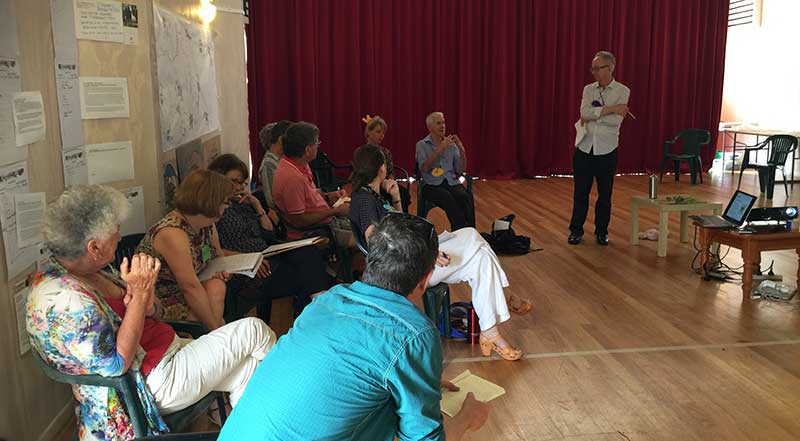
Don Dunoon presenting at the Australian Facilitators’ Network Conference at Ballina/Byron Bay in 2015
“Now, I want to make the Dialogue with OBREAU approach broadly available for anyone, anywhere in the world, to use under Creative Commons licensing. CC BY-NC”
[1] David Bohm and F. David Peat, 1987, Science, Order and Creativity, (p. 241), Bantam Books, Toronto.
Why a Group Might Use DIALOGUE with OBREAU
A Dialogue with OBREAU is especially valuable when:
- The issue is complex, emotionally charged or politically sensitive.
- People hold differing views and tend to talk past each other.
- There is pressure for action, yet uncertainty about what the real issues are.
- Previous conversations have gone in circles or escalated into defensiveness.
Specifically, the process:
- Anchors deliberations in data and evidence, reducing the tendency to begin from firm opinions or interpretations.
- This can help a group ease off on certainty, be more open, and be more willing to consider other possible framings of an issue.
- Expands perspectives by explicitly exploring how the situation may look to other stakeholders, who are assumed to be thinking and acting reasonably now, at least from their own standpoint.
- Participants often say they feel more empathy towards others and less prone to demonise them.

Photo by Josh Calabrese on Unsplash
- Creates a safe space for speaking openly, because participants have already slowed down, focused on evidence, and reflected on others’ perspectives.
- Contributions in the later stages of the dialogue are often more thoughtful and less reactive than in regular meetings.
- Provides a clear sense of progression, helping participants feel the conversation is going somewhere rather than simply recycling familiar arguments
- The identification of three focus areas for further work near the end of the dialogue reinforces this sense of purpose and completion.
Structure and Flow of a Dialogue with OBREAU
A Dialogue with OBREAU ordinarily has five phases, as outlined below. The structure outlined here is for a face-to-face dialogue, though the process can be used virtually as well (however; hybrid versions involving some people in the room and others online can be difficult to facilitate and are not recommended).
- Introduction
- Welcome; introductions; housekeeping; outline of the dialogue purpose, of the focus question and of the Dialogue with OBREAU process
- Grounding the Conversation: Working from Observation
- The purpose is to centre the dialogue in observable data rather than peoples’ reactions, opinions and analyses.
- Shifting Perspectives: Attributing Reasonableness
- The purpose is to help participants stretch beyond their own assumptions and perceptions and consider the dialogue topic in a larger context by explicitly thinking about the possible viewpoints of others.
- From the Heart: Speaking with Authenticity
- The purpose is to enable participants to respond as they wish to what has come up so far in the dialogue.
- Synthesis and Review
- The purpose is to integrate the deliberations thus far and frame three focus areas for further action (or additional exploration, or important areas in which differences remain).
How Long Does a Dialogue with OBREAU Require?
There is no set length/duration of a Dialogue with OBREAU but – for a group of, say, 20-25 people – at least 4 hours (240 minutes) is recommended to do justice to each of the 5 phases. The 4-hour provision is based on: 15 minutes for the Introduction (though longer would be likely be needed if there are any opening presentations), 60 minutes for each of the Observation, Reasonableness and Authenticity phases, and 45 minutes for the Synthesis and Review. Any breaks are additional.
For a small group of, again say, 6 or 7 people, 2 to 2.5 hours could be sufficient (without the need for report-backs and subsequent large group discussion).
While these time provisions might seem generous, keep in mind that:
- Many change efforts (some say 70%) are unsuccessful, and the failure to explore key questions early on may be a factor.
- Dialogue has other benefits other than the prospect of building more widely shared and more solidly grounded understandings on key questions:
- The experience can be developmental for those involved, helping them question their own assumptions and ways of thinking and perceiving
- In experiencing a different form of interaction, group members may grow and develop in their relationships with each other.
If time is tight (and for whom is this not true?), there are potential work arounds.
What Types of Topics/Challenges Are Suitable for Dialogue with OBREAU?
A few examples of potential application areas:
For a town or local community – understanding the implications of a mooted major change in land use
For a business organisation – considering what challenges might be faced in implementing a major change to structure, systems or processes
For a school – exploring how the school might better achieve its mission of catering to the needs of every student
For a healthcare service – examining potential safety risks that are perhaps not being given sufficient attention
For an advocacy group – contemplating the potential implications for their people of a proposed change in legislation
For a university leadership studies class – considering campus-related issues, such as differing perceptions of university policies on access for disadvantaged students
For a government agency – contemplating how a proposed policy might impact different stakeholder groups.
What is an issue/challenge on which your organisation or group might usefully convene a Dialogue with OBREAU?
Summary of Benefits
Individual Dialogue with OBREAU participants will gain in these areas:
The organisation/group will gain in these areas:
Invitation to Use Dialogue with OBREAU
I am delighted to be making the Dialogue with OBREAU model available for use by anyone, anywhere, subject to the provisions of Creative Commons Licensing, Attribution-NonCommercial 4.0 International: CC BY-NC
I’m keen to encourage experimentation and application and am excited about the prospect of Dialogue with OBREAU progressively flowering into widespread use.
I’d love to hear about your efforts and experiences and would be especially grateful for any reports or case studies – even brief ones – and photos you might share. Over time, my intention is to make these available via this site to support learning and practice by others. To get in touch with me, please use the contact form on this site.
Similarly, if you have queries or concerns (including about permissions), please make contact and I will do what I can to help. More in depth assistance, though, will need to be on a paid basis. We can discuss that if you’d like.
With best wishes for your practice of Dialogue with OBREAU!